

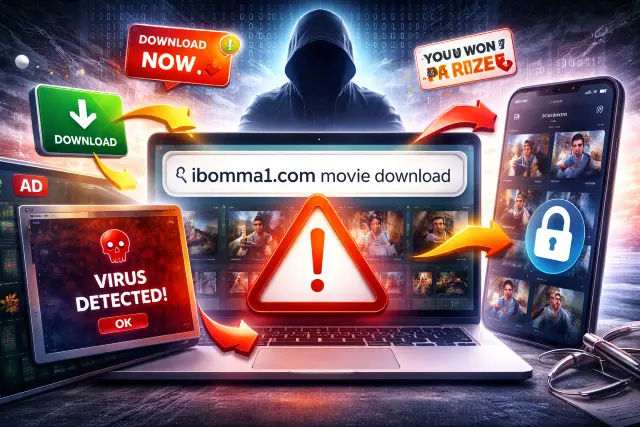
If you landed here after typing ibomma1.com into Google, you are not the only one. Searches like “ibomma1.com movie download” keep trending because people want quick access to entertainment, especially regional releases. But the reality behind those searches is not as simple as “watch a movie.” The ibomma1.com conversation sits at the intersection of piracy, malware risk, data privacy, and crackdowns that make these sites appear, disappear, and reappear under new names.
This guide explains what those searches usually mean, why the risks are bigger than most people expect, and what safer options look like.
What is ibomma1.com, and why do people keep searching it?
People generally search ibomma1.com because they believe it is connected to the iBomma piracy network and related mirror domains that circulate links for “free movies” or “fast downloads.” Indian reporting and official statements have linked iBomma operations to large-scale piracy activity, heavy user traffic, and constant domain switching to evade blocks.
There is also a second reason searches spike: confusion. When a well-known piracy brand gets blocked, lookalike domains often pop up and users start hunting for “the new working link.” Deccan Chronicle reported that after iBomma was blocked and arrests happened, new platforms emerged attempting to impersonate the original site.
So when you see “ibomma1.com movie download” trending, it often reflects:
- people chasing mirror links after blocks
- people trying to access newly released movies quickly
- people being redirected by social media forwards, WhatsApp links, or pop-ups
The uncomfortable truth: “movie download” searches are a magnet for cyber risk
Piracy sites are not just a copyright problem. They are also a high-risk browsing environment.
1) Malware and spyware risks are real
The U.S. Federal Trade Commission warns that criminals use appealing websites and desirable downloads to lure people into clicking links that install malware or spyware, including tools that can monitor browsing or record keystrokes and lead to identity theft.
That matters here because “download” intent is exactly what attackers want. If a user is primed to click quickly, ignore warnings, and chase a file, the odds of a bad click go up.
2) Piracy can expose you to identity and financial theft
INTERPOL notes that digital piracy can put consumers at risk of financial loss and security risks such as ID theft, and it also highlights broader harms to creative industries.
In plain words: the cost of “free” can be your data.
3) Real police investigations have flagged user data concerns
In a Hyderabad Police press note, iBomma is described as attracting around 5 million users per month, and authorities describe how operators used multiple domains and rapid switching when blocks occurred.
Separate reporting also alleged collection of user data connected to the network.
You do not have to be “important” to be targeted. Mass traffic is the point. High-traffic piracy pages are valuable because even a tiny percentage of infected clicks can make money for bad actors.
Why ibomma1.com links keep changing or “not opening”
If you have ever tried to open a link and found it down, blocked, or redirecting to random pages, that pattern is not accidental.
Domain switching is part of the model
Hyderabad Police noted operators maintained backups and intended to quickly launch new domain extensions when existing ones were blocked by the Ministry of Information & Broadcasting.
Court orders are getting more aggressive
In January 2026, New Indian Express reported on Delhi High Court orders to block piracy websites through a “dynamic+ injunction” approach designed to curb mirror sites too.
That helps explain why users keep searching different variants. Blocks trigger new mirrors. New mirrors trigger new searches. It becomes an endless loop.
Redirects and pop-ups are not a “bug”
Hyderabad cybercrime reporting described how iBomma traffic was allegedly used as a gateway to redirect visitors to illegal betting and gaming portals.
So if a site opens and suddenly pushes you to unrelated pages, that is not surprising. Many such sites monetize traffic through aggressive ads and redirections.
The biggest risks of ibomma1.com type searches (explained simply)
Here is the reality check most people wish they had earlier.
Risk 1: Malware infections that slow or lock your device
Common outcomes include:
- constant pop-ups even after you close the browser
- apps you did not install showing up
- browser homepage or search engine changing
- random redirects
The FTC specifically describes spyware that can redirect users to unwanted sites or record keystrokes.
Risk 2: Data leaks and privacy loss
If a piracy network is collecting traffic data or routing users through ad networks and trackers, it becomes easier for third parties to profile users. And if investigations allege access to user details, that is even more concerning.
Risk 3: Financial scams through “verification” traps
A classic tactic is fake prompts like:
- “Allow notifications to continue”
- “Install this player”
- “Verify you are not a robot”
- “Download manager required”
These are often just ways to push spam notifications, adware, or malicious installers.
Risk 4: Legal exposure and crackdowns
The focus of enforcement is usually on operators, but anti-piracy actions are increasing, and courts are issuing broader blocking orders.
Even if you never face legal trouble, you still face practical consequences: broken links, low reliability, and risk-heavy browsing.
Quick reality table: what users expect vs what actually happens
| What people expect from “ibomma1.com movie download” | What often happens instead |
|---|---|
| A clean download button | Multiple redirects and pop-ups |
| One working site | Domain switching and blocks |
| “Free” entertainment | Hidden costs: malware, tracking, scams |
| Quick access to new releases | Unstable links, fake mirrors, impersonators |
How to recognize red flags quickly (so you do not get trapped)
If you are researching ibomma1.com because someone sent you a link, use this checklist before doing anything else.
Red flags that should make you close the tab
- A popup asking you to allow notifications to continue
- A forced redirect to betting, gaming, or adult pages
- A download that is an .apk, .exe, or “player installer”
- Fake “scan your device” warnings
- Too many mirror domain variants that look slightly different
Red flags that suggest an impersonation site
Deccan Chronicle highlighted the rise of impersonators after iBomma blocks.
That matters because copycat sites often exist purely to farm clicks or push malware, not even to host content.
What to do if you already clicked something
No panic. Just do the sensible cleanup steps.
If you downloaded a file but did not open it
- Delete it
- Empty your recycle bin
- Run a trusted security scan
- Check your browser extensions and remove anything unfamiliar
If you allowed notifications
- Go to your browser settings and remove notification permissions for suspicious sites
- Clear browsing data
- Restart the browser

If your phone installed something suspicious
- Uninstall the unknown app
- Check device admin apps and accessibility permissions
- Run a mobile security scan
- If the phone remains unstable, back up photos and reset
The point is not to scare you. It is to help you recover quickly if a click went wrong.
Why “free movie” sites monetize your attention so aggressively
This is the business side most people never think about.
Piracy operators often depend on:
- ads that pay per click or per redirect
- “affiliate” traffic deals (including risky categories)
- pushing users into sign-ups or app installs
- harvesting user data
Hyderabad cybercrime reporting alleged iBomma traffic was used to redirect users to betting portals and earn commissions.
So when a site behaves like a casino billboard, it is because traffic is the product.
“But everyone uses it” is not a safety argument
A huge number of people visiting a site does not make it safe. In fact, it can make it more attractive to criminals.
The Hyderabad Police press note described iBomma as drawing about 5 million users per month, which is exactly the kind of scale that turns a site into a prime target for ad abuse, tracking, and malware distribution.
Safer ways to watch movies without the ibomma1.com risk loop
This article is not here to judge anyone. People want entertainment that is affordable and accessible. But if your goal is to avoid malware, scams, and chaos, you need options that do not rely on shady redirects.
Practical, safe alternatives most people overlook
- Official streaming subscriptions (often cheaper when shared within family plans where allowed)
- Renting a single movie instead of paying for multiple services
- Free, legal ad-supported platforms (availability varies by country)
- Waiting for official OTT release dates rather than chasing “day one” pirated prints
Also remember: when courts increase blocking and dynamic injunctions expand, piracy sites become even less reliable.
FAQ about ibomma1.com searches
Is ibomma1.com the same as iBomma?
People search it as if it is related, but the bigger point is that iBomma has had many mirror domains and impersonators, especially after blocks and arrests.
Why does the site redirect to random pages?
Because traffic is monetized. Reporting described iBomma traffic allegedly being used to redirect visitors to betting portals.
Is it dangerous to click “download” on piracy sites?
It can be. The FTC warns that criminals use desirable downloads and compelling links to install malware or spyware that may lead to identity theft.
Why do these sites keep getting blocked?
Courts and authorities act against piracy, including orders designed to block mirror sites too.
Conclusion: ibomma1.com searches are not just about movies
The search term ibomma1.com looks like a simple entertainment shortcut, but it often leads into a messy world of mirror domains, impersonators, redirects, and real cyber risk. Official police notes and reporting have linked iBomma style networks to massive traffic, domain switching, and monetization tactics that can expose users to scams and privacy issues. Add the FTC and INTERPOL warnings about malware, spyware, and identity theft risk around illicit online behavior, and the “free download” temptation starts to look expensive.
If you want the simplest takeaway, it is this: do not treat piracy links like normal websites. They are unstable by design, and the ecosystem around them rewards risky clicks. The safest move is to step out of the loop and choose legitimate viewing options whenever you can.